Wednesday, 17 July 2013

Modern Learning Environments

Learning environments or classroom spaces define the space in in which students learn.
Traditionally and sadly still recognizable is the classroom with a big whiteboard / chalkboard at one end with the teachers desk, and all the student desks lined up like little soldiers.  
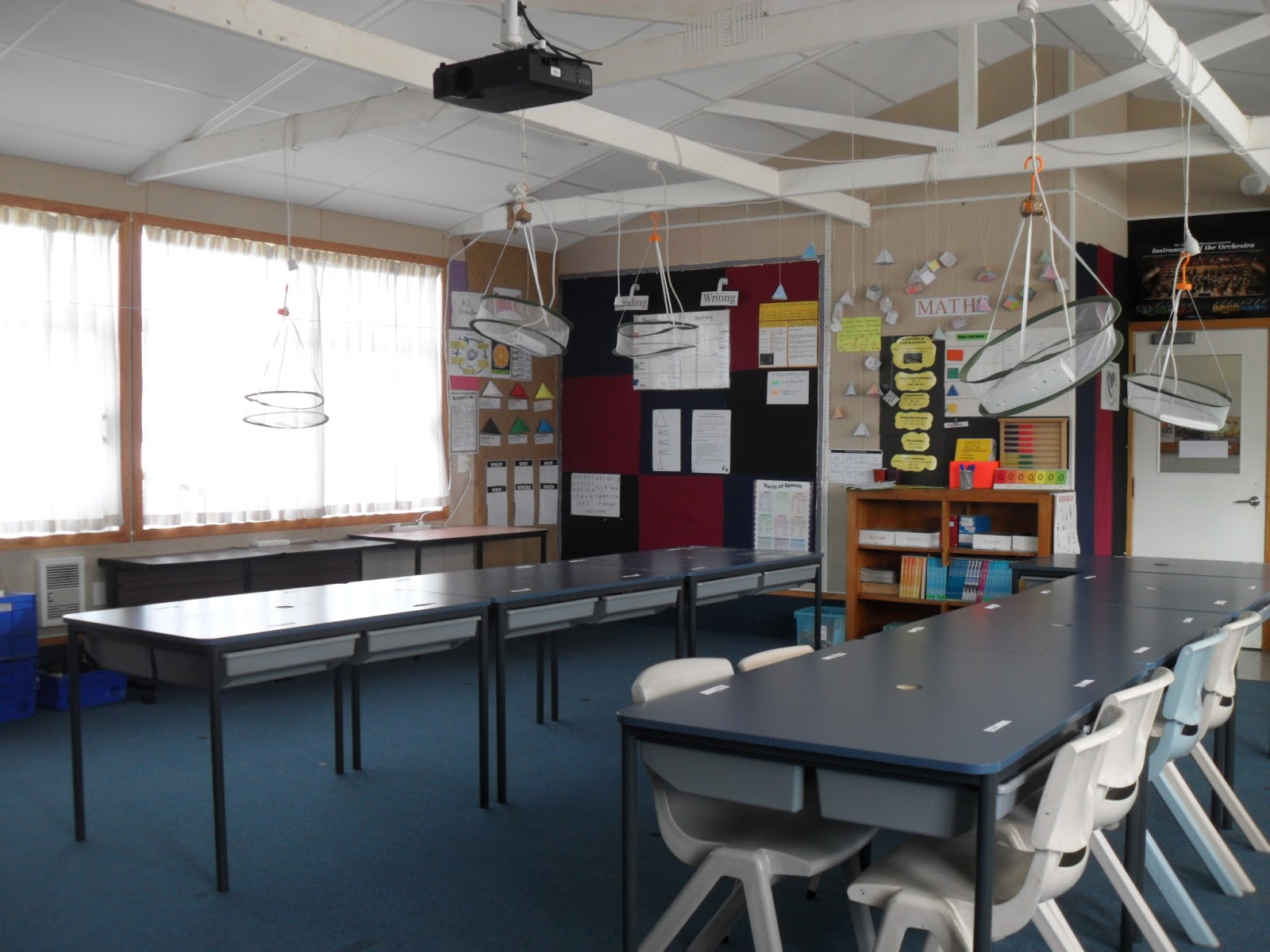

Early on as a trainee teacher I started thinking about what "The Classroom of the Future" would look like.  I already believed that learning environments should foster a social learning community where the teacher is a guide and learner in both physical and digital spaces. 

In my first year of teaching I went to observe an inspiring teacher (Jacqui Sharp) I had heard about through reading blogs.  My first impressions when walking into her classroom was that it was so open, no ‘personal’ desks or spaces, no rows or group tables, rather a less formal learning environment with digital centers.  When I got back to my class and started rearranging; first I moved the desks into different shapes but eventually traded them for tables.  The tables came in many shapes and colours as I scavenged them from around the school.  

The following year I joined a group of like-minded teachers who were experimenting with classroom spaces and elearning at http://elearningclassroom.wikispaces.com. We were inspired by Ewan McIntosh talk about the Seven Spaces in a classroom in his 'Clicks and Bricks: When Digital, Learning and Physical spaces meet.'  


1. Secret Spaces: spaces to be alone, a quiet space.
2. Group Spaces: are spaces in the classroom for collaborative team work; and also online collaborative spaces like wikis, blogs, Skype, Twiducate, Google Docs etc.
3. Publishing Spaces: Technology allow a larger audience and range of tools.
4. Performance Spaces: although arts related, it is often linked to multiple learning styles to personalise for learners.
5. Participation Spaces: spaces that encourage students to study their ecological footprint through various curriculum areas.  Online spaces include virtual field trips around New Zealand and the world.
6. Watching Spaces: reminds me of the old 'listening station', although I am tempted to call this space the performance space, or perhaps a combination of the two.
7. Data Spaces: gathering real time school data to inform learning

The fun part was doing group visits of each others classroom spaces and reflecting on our various success and failures.  I learnt that although the seven spaces are often combined or adapted to suit the age and classroom learners.  Each term would alter my spaces and reflect on how they engaged my students to learn in a space that suited them.  During this time I had many teachers frown when seeing a student writing under a desk, "but they are writing" I would say.  Luckily I had an enlightened principal who was happy to use my class as a test case as we explored spaces, tables instead of desks, unique furniture and of course our digital spaces too.  Here are some photos from those days of experimenting with learning spaces. 

At the start of 2012 I joined Hingaia Peninsula School as a foundation member, this school had been designed and built based on some of the notions of the Campfire, the Watering Hole, and Cave Space from The Language of School Design by Prakash Nair, Randall Fielding and Dr. Jeffery Lackney.

The studios (see the school presentation PDF here) are an open plan design that takes the place of three traditional classrooms, with teachers working collaboratively within these spaces.  
To the left is the layout of the studios and many of the seven spaces are represented here.  Along with great range of bright colours and fun furniture, it made an exciting learning spaces. 

It can get quiet noisy and you have less personal space.  I have seen some one school that put small offices between classes, five minutes of solitude are sometimes needed in a teachers day.

Below is an EdTalk about our learning environments with interviews with the principle and many of my students.  See what they think of these spaces?

Modern Learning Environments: Hingaia Peninsula School from EDtalks on Vimeo.

Finally with a major school rebuild happening in Christchurch, educators are starting to look at new ways of thinking about the learning spaces that engage our modern students.  This discussion at a Christchurch educators conference led to my school being featured on local TV.

Bringing the Kiwi classroom into the digital age - Campbell Live - Video - 3 News

Modern learning environments are just a reflection of the forerunners in the business world.  Telecom and Westpac in Auckland are both good examples of the changing workplace environments.  However modern learning environments end up looking I hope they do not need to be carbon copies of other schools, or the same classrooms; who says they need to be in the same anything?  As long as they can provide an environment in which each student can be inspired to become a learner.

What does your learning environment look like?

For your further exploration:
Dr Kenn Fisher on: Linking pedagogy and space, curriculum context, planning principals, along with case studies. 
http://openlearningspaces.blogspot.co.nz Chris Bradbeer's blog on open learning spaces.
Modern Learning Environments: Three NZ Case Studies

Saturday, 1 June 2013

Build a School in the Cloud

Twitter was buzzing with amazing ideas and discussions this morning; I love being able to do self directed PD without leaving the warmth of my bed.  It led me to a blog post by "connected principal" Cale Birk on Self-Organized Learning, and this Edtalk (below) "Build a School in the Cloud" by Sugata Mitra.  

It is inspiring to see given SOLE children can learn anything on their own: broadband to access knowledge + collaboration to test and challenge + positive encouragement to engage and inspire "peer tutoring".  

I was rather in awe of his "granny cloud" to encourage and support students, I have always though it is sad that in todays society we have lost the wisdom and companionship of our older generation by sticking them into homes.   How could we harness this idea in our local communities and schools?

Although not a new approach, sending students on intellectual adventures driven by big questions is a key to inspiring self-organized learning.  Watch the video below and see if you get inspired too.


This paragraph I added a few days after writing this post, as I read an interesting counter view to Sugata Mitra's "Hole in the Wall".  Donald Clark rightly points out many holes in Sugata's wall.  Coming from South Africa I can relate to what happened to the experiment there, like any resource the strong dominate and the desperate steal.  Over time this experiment seems to lack convincing data.

Still I think there is some great inspiration and a many ideas we can take from the "hole in the wall" experiment in order to bringing learning to our students.  Even it is only to take a chance, be bold, don't let teaching or learning stagnate.


Tuesday, 21 May 2013

MOOC Certificate in Gamification

This year I took part in my first MOOC through the University of Pennsylvania; Gamification.  

I have always been fascinated with using games for learning, and am convinced they are brilliant pedagogical tools.  Through a great VLN I learnt that games play many roles in education, including gamifaction which is the application of game elements and game design to non-game problems.  In this course I learnt to appreciate the incredible potential of gamification.  I learnt to use game mechanisms strategically and apply the elements effectively.  As all teachers know, just sticking a badge on it does not provide intrinsic motivation for students to learn, but gamification applied thoughtfully and appropriately to the context can be a powerful and engaging motivator.

I passed Gamification with 84.2%, and will be gamifying the future of learning!

Thursday, 16 May 2013

The F Word


What is a game?  Wikipedia says it is structured playing, yet ask around and you will get as many different definitions.  I think a game is an activity with a prelusory goal within the confines of voluntarily constitutive rules; in other words, structure and attitude.  But what makes playing games so engaging is that they are FUN.


Vygotsky (1978) said, "play creates a zone of proximal development of the child. In play a child always behaves beyond his average age, above his daily behavior; in play it is as though he were a head taller than himself. As in the focus of a magnifying glass, play contains all developmental tendencies in a condensed form and is itself a major source of development."


Fun can be many things to many people, yet fun is always highly engaging to all people.  Through research,  XEODesign discovered The 4 Keys to Fun which is a model for thinking about fun.  It is also useful for planning for fun learning experiences or gamification that engages players at the 'right' level of fun; even fun can get boring eventually.  The four types of fun are: easy fun, hard fun, people fun, and serious fun.  


Fun is a powerful motivator and finding the fun in everyday experiences can be used in gamification, in education, or to change social behavior.  Thefuntheory.com believe that the easiest way to change people’s behavior is to find that fun, and I totally agree, this is my favorite.


Finally, I encourage you to try fit that F word in your teaching and learning.


References
The 4 Keys to Fun retrieve from http://www.xeodesign.com/research.html on 16 May 2013.

Vygotsky, L. (1978). The Role of Play in Development retrieved from http://www.igs.net/~pballan/RoleofPlayinDevelopment(Vygotsky,1978).htm on 16 May 2013. 

Sunday, 12 May 2013

Avoid Spam with an Email Icon

Spam seems to come and go in waves, sometimes just ripples but other times a tsunami!   One way to lessen your spam is to avoid having your email typed on your webpages; "spider" programmes trawl the net and collect emails for spammers.  

As I have just been updating one of my sites, I found this easy email icon generator which turns your email into an image.  Now dumb "spiders" can't read and collect my email, yay!


Saturday, 11 May 2013

Ken Robinson: How to escape education's death valley


In this inspiring TED talk, Sir Ken Robinson outlines three principles crucial for the human mind to flourish; diversity, curiosity and creativity He says they are however contradicted by the culture education under which most teachers must labor & students endue.

1. All students are different: give equal weight to other curriculum areas
2. Teaching is a creative system not a delivery system (the point of education is to get people to learn - the role of the teacher is to facilitate learning).
3. Human life is inherently creative: being opposed by the current culture of standardization.

Sir Ken states that great leaders should know that: education is not a mechanical system it is a human system - the culture of a school provides the conditions for learning to happen -  teachers and students need discretion to be creative and innovative in what they do. The real role of leadership at state or school level should not be command and control; it is climate control, creating a climate of possibility for learning.


Friday, 3 May 2013

Game Based Learning vs Gamification


In order to use games and/or gamification purposely in education we need to start with understanding the difference between Game Based Learning or Gamification?  

Game Based Learning or GBL is using games for learning; they are usually topic, concept or skill specific, in order to teach or provide practice in achieving some clear learning outcomes. GBL is a useful and engaging tool to reinforce or scaffold a learner, like any tool in a teachers kete, it needs to be the right one at the right time to be effective. 

GBL and Gamification sometimes overlap. Where there are games with clear learning objectives, but are also using gamification (points, badges, leader boards) within the game (Lure of the Labyrinth).  Or using using a range of GBL games to teach smaller chunks of skills; but tying them together using a social gamification framework like, Mathletics or Sumdog.

Gamification is the process of using game design, elements and game thinking in order to apply them to non-game contexts to engage your players to achieve your objectives.  Some examples are FourSquare in the entertainment area, or Linkedin who use profile completion bars effectively.
  1. Game elements are points, leveling up, collecting resources, quests, avatars, and social graphs.
  2. Game design techniques are planning your objectives and designing fun activities for your players.
"Play creates a zone of proximal development of the child.  In play a child always behaves beyond his average age." Lev Vegotsky

Why study gamification?  Games are powerful things with strong links to the psychology of motivation.  The encourage rich immersion and use strategies to scaffold, give feedback, challenge and reward.  Data is able to be easily tracked for assessment. 

Where is it already being used?
- Edmodo is an excellent social network style learning site which now offers badges.


Gamification is not a "ready to bake" mix guaranteed to work every time.  It is like teaching, taking a range of tools and techniques and putting them together with just the right mix of magic.  So Gamification in education can and will take many forms, not all will work and not all situations are suitable for it either.  But it does have the potential to transform learning experiences and make life long learning a game worth playing.

I have always been fascinated by Game Based Learning and Gamification because learning should be fun.  Do you have any examples of Game Based Learning or Gamification in education?