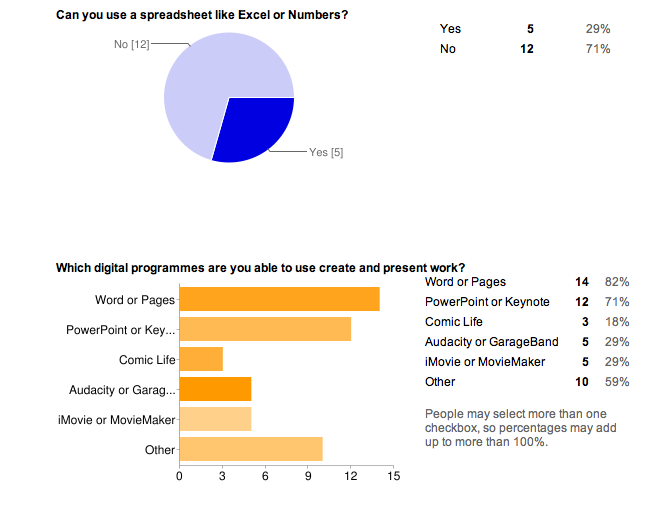
In the past this ICT survey had been been in a printed format. The ICT Skills Survey had a check list of skills expected at each Year level. I am not sure if it was ever successfully used.
Our ICT team put some work into rewording it to better suit our students. I then converted twoYear levels into my beloved Google Forms and convinced the team to assist me to create an online survey for every Year level. The aim is for each teacher to walk their students through the survey.
On the left is a snapshot of part of the survey. The questions are not perfect and I would love to see more questions about collaboration, multimodal storytelling, maths game scores, etc. but it is a start.
My students had little difficulty and the result were worthy of reflection. Future teaching needs became clearer, although whether I can cover all gaps in two terms is another matter.
Being a visual person I love graphed information (see my students blog on class culture) and find it easier to interpret them. That is another reason I love Google Forms.
Below are the results of just my class. For me this is a valuable student self-assessment that can help inform me of my classes ICT strengths and needs. I won't interpret it for you as I think the whole idea is that visuals allow you to make your own quick evaluation. When all the classes have done this it will provide a decent set of results for reporting to the school board.
Have you done anything similar or can offer some ways I could improve this next time?
Tuesday, 27 July 2010
Saturday, 24 July 2010
Virtually at EducampNZ 2010
One of my less useful super powers is getting lost anywhere, which I did remarkably well today. I was planning to attend the unconference EducampNZ 2010. I went to last years one and it was a great place to meet PLN's and share our learning. However, I first managed to get onto the wrong highway then eventually to the right area, but after an hour and a half I couln't take any more traffic and decided to go home.
Dispite my frustration I could not help but do as many others were doing today and attend virtually. These were the options:
- Follow and join individual conversations on Twitter hashtag #educampnz
- Read their wiki page
- Share ideas on the wallwisher
- Or say how you felt about it using AnswerGarden
Nothing can substitute for being physically at a conference but here are my thoughts on what it was like as a virtual participant. I got some great ideas from the sharing on the wallwisher, particularly AnswerGarden which I thought has lots of potential in the classroom as a brainstorming tool. The wiki page was an essential gateway and reference point although was not an active virtual environment.
The main virtual involvement was via the Twitter hashtag #educampnz which you can still search and follow the conversations of the day. However the online conversations were few, mere tantalizing glimpses into the subjects being explored. It left me wondering how we could plan for and ensure a more active virtual presence at conferences like this, so people who cannot physically attend can take a bigger part in the sharing and learning. Any ideas?
What did you think of Educampnz 2010... at AnswerGarden.ch.
Dispite my frustration I could not help but do as many others were doing today and attend virtually. These were the options:
- Follow and join individual conversations on Twitter hashtag #educampnz
- Read their wiki page
- Share ideas on the wallwisher
- Or say how you felt about it using AnswerGarden
Nothing can substitute for being physically at a conference but here are my thoughts on what it was like as a virtual participant. I got some great ideas from the sharing on the wallwisher, particularly AnswerGarden which I thought has lots of potential in the classroom as a brainstorming tool. The wiki page was an essential gateway and reference point although was not an active virtual environment.
The main virtual involvement was via the Twitter hashtag #educampnz which you can still search and follow the conversations of the day. However the online conversations were few, mere tantalizing glimpses into the subjects being explored. It left me wondering how we could plan for and ensure a more active virtual presence at conferences like this, so people who cannot physically attend can take a bigger part in the sharing and learning. Any ideas?
What did you think of Educampnz 2010... at AnswerGarden.ch.
Sunday, 13 June 2010
Unpacking the Labels
At my most recent beginning teacher professional development day we were lucky enough to have a lecture by Dr Frances E. Steinberg on identifying, understanding and some practical solutions for children with Attention-Deficit Hyperactivity Disorder (AD/HA), Fetal Alcohol Syndrome (FAS), Fetal Alcohol Spectrum Disorder (FASD), Autistic Disorder and Asperger's Disorder.
There was much discussion at this point about the different diagnoses teachers had in their classrooms, some even having students diagnosed as both AD/HA and Asperger's, which we learnt is not possible. The outcome was we started to realise how little we knew about these disorders and we were not alone as there are many mis-diagnosed children in our classrooms. One interesting reason for this is that there really are no clinical laboratory tests that can be done to ascertain these disorders. They require a checklist of criteria as well as some exclusions to be assessed. Even with a sound understanding it is a judgement call in the end.
An interesting facts about AD/HD is that their behaviour is always impulsive, therefore if a child can "pause" to check their audience then they are NOT AD/HD. They will often have a range of processing difficulties in one or more combinded modualities e.g: visual/audiitory. Often a key to engaging them is integrating what thye are good at into curriculum areas. She then went on to discuss AD/HD in more detail along with many practical ideas to implement in the classroom.
When we starting learning about Fetal Alcohol Syndrome (FAS) and Fetal Alcohol Spectrum Disorder (FASD), I was amazed and horrified to discover it ONLY TAKES ONE DRINK during pregnancy to give your baby this disorder, ONLY ONE! The photos of a baby's FAS brain compared to a normal brain of that age, explain everything. This is probably something we can all expect to see in our classes, and understand along with some practical strategies are the key to helping them learn.
I couldn't begin to cover the extent of ideas and information I gained on this day but I do feel more confident in my own ability to discuss one of these children's condition and learning requirements with professionals and parents. The bottom line for me is as a teacher I must understand my students to plan to meet their learning needs.
Do you have any experience or ideas to share?
Photo by crowolf
There was much discussion at this point about the different diagnoses teachers had in their classrooms, some even having students diagnosed as both AD/HA and Asperger's, which we learnt is not possible. The outcome was we started to realise how little we knew about these disorders and we were not alone as there are many mis-diagnosed children in our classrooms. One interesting reason for this is that there really are no clinical laboratory tests that can be done to ascertain these disorders. They require a checklist of criteria as well as some exclusions to be assessed. Even with a sound understanding it is a judgement call in the end.
An interesting facts about AD/HD is that their behaviour is always impulsive, therefore if a child can "pause" to check their audience then they are NOT AD/HD. They will often have a range of processing difficulties in one or more combinded modualities e.g: visual/audiitory. Often a key to engaging them is integrating what thye are good at into curriculum areas. She then went on to discuss AD/HD in more detail along with many practical ideas to implement in the classroom.
When we starting learning about Fetal Alcohol Syndrome (FAS) and Fetal Alcohol Spectrum Disorder (FASD), I was amazed and horrified to discover it ONLY TAKES ONE DRINK during pregnancy to give your baby this disorder, ONLY ONE! The photos of a baby's FAS brain compared to a normal brain of that age, explain everything. This is probably something we can all expect to see in our classes, and understand along with some practical strategies are the key to helping them learn.
I couldn't begin to cover the extent of ideas and information I gained on this day but I do feel more confident in my own ability to discuss one of these children's condition and learning requirements with professionals and parents. The bottom line for me is as a teacher I must understand my students to plan to meet their learning needs.
Do you have any experience or ideas to share?
Photo by crowolf
Wednesday, 9 June 2010
The Education Revolution
One of my favourtite blogs for inspiring range of classroom ideas is iLearn Technology which now has a TED Talk Tuesday where she will share an inspiring TED Talk. It is a blog worth following for just that reason. If you don't know about TED, it is non-profit organization that brings together people from a wide range of professions who have one thing in common, and that is to share ideas for a better world.
This TED Talk is Sir Ken Robinson’s latest TED Talk, "Bring on the Learning Revolution." I share his ideas of change and believe that even though we are caught in the gripping flow of this old education system, each one of us can start to make tiny ripples of change.
Tuesday, 18 May 2010
Mind42 is Magic at Mind Mapping
Thanks to Jacqui Sharp I discovered Mind42.com which allows you to easily create neat looking mind-maps along with links and images. You do not seem to be able to upload images from file, url only. Also I haven't been able to resize the images, so you would need to plan your images for this.
I love how you can collaborate on a mind-map; this functions reminds me of EtherPad. The best part by far is that you can embed it on blogs and wikis. Unfortunately it will not embed on Kidblogs yet as they are still working on allowing iframes.
I am already using this with my students to plan, and my next step will be to use it collaboratively. I was also thinking of using it alongside net research as a guide and note taking place.
Do you have any other ideas on how to use it in the classroom?
I love how you can collaborate on a mind-map; this functions reminds me of EtherPad. The best part by far is that you can embed it on blogs and wikis. Unfortunately it will not embed on Kidblogs yet as they are still working on allowing iframes.
I am already using this with my students to plan, and my next step will be to use it collaboratively. I was also thinking of using it alongside net research as a guide and note taking place.
Do you have any other ideas on how to use it in the classroom?
Thursday, 8 April 2010
Dennis Hong: My seven species of robot | Video on TED.com
This is an inspiring TED talk by Dennis Hong where he introduces seven all-terrain robots. I had no idea how far robotics had been taken and the robots are fantastic. The part that made me think about sharing this with my class, was when he spoke about the five creative secrets to his lab's success. He talks about the kind of brainstorming I try to encourage in the classroom, perhaps a real life example will inspire my students onward. Dennis goes on further to say that creativity itself is not enough, to support it and follow through you need the learning; lots of maths and science.
Wednesday, 7 April 2010
Pixton Click-N-Drag Comics
Pixton Click-N-Drag Comics is an amazing online comic site with a huge range of characters and editable features. You can resize, rotate and change clothes, colours and even move individual limbs on the characters. Backgrounds and objects seem just as versatile. Most comic formats from one row to twelve rows are included as well as a poster format. This is really click and drag storytelling that allows the story teller to explore the visual elements of storytelling.
I am impressed with the easy of use and versatility of this site. I especially like how easy it is to embed your comic creations on your blog or share on on social sites. All this is free, although Pixton also have a pay version with extra features.
While sharing this on Twitter @wmchamberlain mentioned that with the free version students had to be 19, or have parent permission to sign up their own account. There is an education version which bypasses this, but it is not free. As I don't like my students being asked for emails, I plan to use my usual option of opening a class account that we all can use.
Some other comic options are:
Creating Comics in Word written by Jacqui Sharp
Speak Up: good for bully stories and have a downloadable option.
Zimmer Twins creates digital movie stories.
Make Beliefs Comixs
Toondoo
PikiKids uses photos like creating comics in Word.
Myths & Legends
Comic Creator by ReadWriteThink allows you to create comics to print out and colour. You cannot save or embed though.
Have you use an online comic creator with primary school students? How would you rate it?
Subscribe to:
Posts (Atom)